
Use this template
Add your own experience and make this layout yours.
Resume Example
Evelyn Harris
Chief of Staff - Executive Operations and Strategic Planning
[email protected] | +1 (555) 987-6543 | linkedin.com/in/evelyn-harris | evelynharris.com | San Francisco, CA
Professional Summary
Chief of Staff with 6+ years of experience turning executive priorities into clear operating plans, leadership cadences, and cross-functional initiatives. Known for improving project intake, onboarding, and decision-making routines across scaling teams. Brings strong judgment, stakeholder management, and practical process design to help senior leaders move faster without losing clarity.
Work Experience
Chief of Staff - Executive Operations
01/2022
Global Tech Solutions Inc.
San Francisco, CA
•
Led operating rhythms for a growing 300-person organization, aligning executive priorities, department plans, and weekly decision forums across product, sales, people, and finance.
•
Redesigned project intake and executive review workflows, cutting average launch approval time from 3 months to under 6 weeks while improving handoffs between teams.
•
Partnered with People Operations to rebuild onboarding for managers and new hires, raising first-90-day retention by 25% through clearer ownership, training paths, and feedback loops.
•
Built a cross-department communication framework for planning updates, risks, and decisions, reducing duplicated work and missed handoffs by 30%.
Chief of Staff - Organizational Development
06/2020 - 12/2021
InnovateNow Corp.
San Francisco, CA
•
Coordinated a company-wide reorganization that clarified reporting lines, decision rights, and operating metrics across customer-facing and internal teams.
•
Created manager enablement workshops focused on prioritization, meeting discipline, and change communication, improving leadership survey scores by 40%.
Strategic Initiatives Lead
12/2018 - 05/2020
Pioneer Enterprises
San Francisco, CA
•
Managed a $500K employee engagement initiative, tying budget requests to participation goals, leadership sponsorship, and quarterly progress reporting.
•
Worked with external advisors and department leads to document process gaps, prioritize improvements, and identify $100K in annual operating savings.
Skills
Strategic Visioning, Project Management, Change Management, Process Optimization, Stakeholder Management, Team Leadership, Conflict Resolution, Cross-functional Collaboration
Education
Master of Business Administration (MBA)
09/2017 - 05/2019
XYZ University
San Francisco, CA
Projects
Digital Transformation Workshop Series
Designed and facilitated a digital operations workshop series for small businesses, helping leaders map manual workflows, choose practical tools, and plan technology adoption.
Operational Efficiency Hackathon Mentorship
Mentored teams during an operational efficiency hackathon, guiding participants to scope process problems, test solutions, and present measurable workflow improvements.
Certifications
Certified Digital Transformation Professional (CDTP)
05/2025
Strategic Leadership Certificate
10/2024
This resume format works well for ATS by including key action verbs like 'spearheaded', 'optimized', and 'streamlined'. It also highlights measurable accomplishments such as increased efficiency rates or successful project completion percentages, which are crucial for ATS systems to pick up on. The inclusion of relevant keywords pertinent to the Chief of Staff role ensures that both human readers and automated systems can easily identify the candidate's expertise.
Instant Resume Score
Upload your resume for an instant ATS score and practical, role-specific improvements.
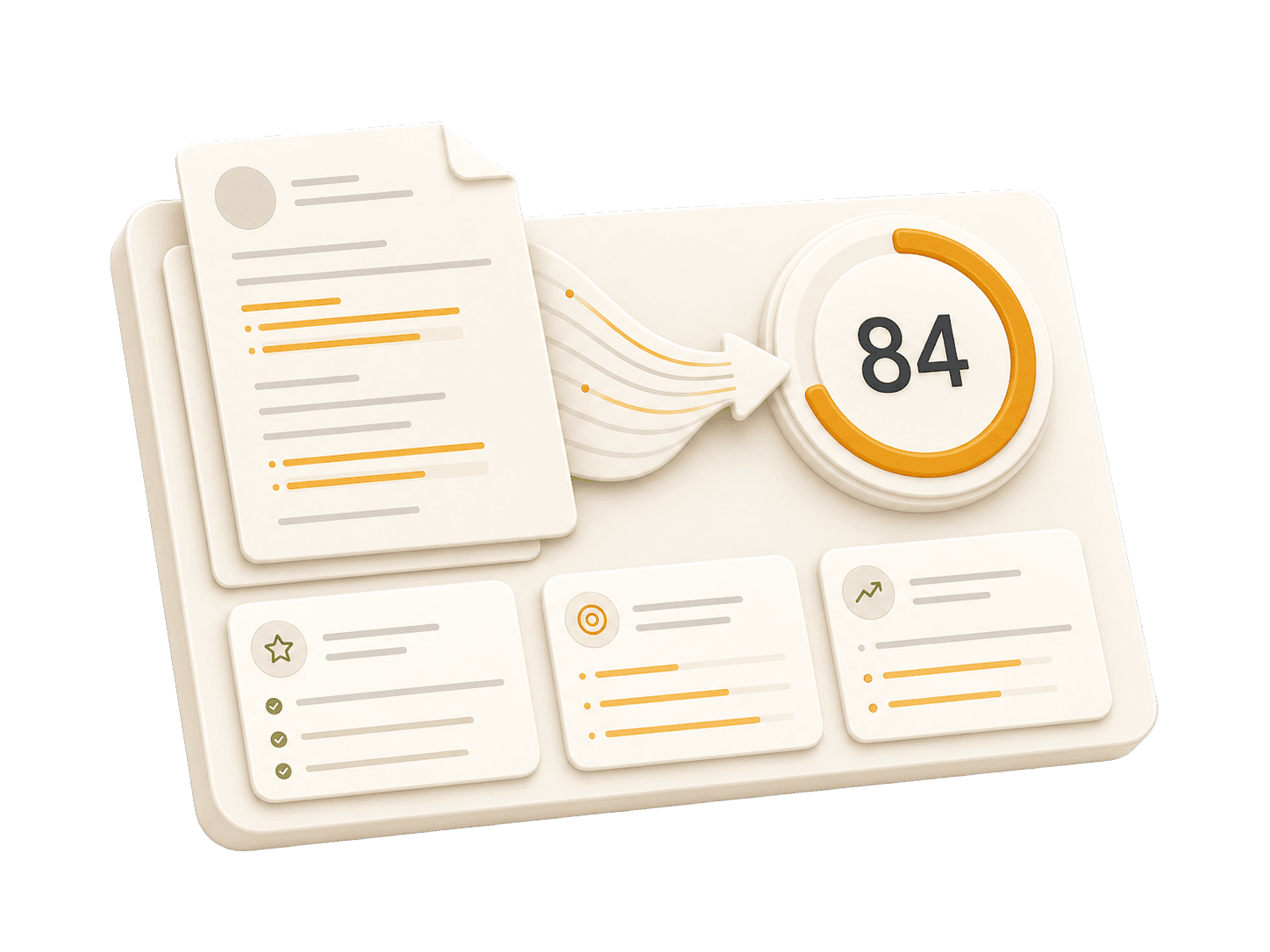
Add your resume to run a free score and get prioritized fixes.
Expert guidelines and best practices for each section of your resume.
01
First Name Last Name City, State, Zip Code Phone Number | Email Address LinkedIn Profile URL | Portfolio URL (Optional)
Your contact information is the first section recruiters see. Keep it concise and professional. Ensure your email address is appropriate (e.g., [email protected]). Include your LinkedIn profile for a comprehensive view of your professional journey. A portfolio or personal website is recommended for creative, technical, or design roles.
Do not include your full physical address (street number/name) for privacy reasons. Avoid including personal details like marital status, age, photo, or social security number unless specifically required in your country. Do not use unprofessional email addresses such as nicknames or casual usernames.
See clear examples of how to format contact details effectively.
John Doe 1234 Random St, Apt 56 New York, NY 10001 [email protected] github.com/aliciacode Single, 28 years old
John Doe New York, NY (555) 123-4567 | [email protected] linkedin.com/in/johndoe | johndoe.com
02
Professional Title Result-oriented [Role Name] with [Number] years of experience in [Key Skills/Industries]. Proven track record of [Major Achievement]. Skilled in [Key Technologies/Skills]. Committed to delivering [Specific Value] for [Target Industry/Company type].
A professional summary is your elevator pitch. It should be 3-5 sentences long, summarizing your experience, key skills, and major achievements. Tailor it to the job description by using relevant keywords. Focus on what makes you unique and the value you bring to potential employers.
Avoid generic objectives like 'Looking for a challenging role to grow my skills.' Recruiters want to know what value you bring to them, not what you want from them. Don't use first-person pronouns (I, me, my). Keep it concise and impactful.
Compare a weak objective with a strong professional summary.
Objective: I am a hard-working individual looking for a Chief of Staff position where I can learn new things and advance my career.
Chief of Staff with 6+ years of experience in executive operations, planning cadence, and cross-functional program leadership. Improved project intake and leadership reporting for a scaling 300-person organization, reducing approval time from 3 months to under 6 weeks. Skilled in stakeholder management, operating rhythms, change communication, and practical process design.
03
Technical Skills - Languages: [List] - Frameworks: [List] - Tools: [List] Soft Skills - [Skill 1], [Skill 2], [Skill 3]
Group your skills logically (e.g., Languages, Frameworks, Tools). Focus on hard skills relevant to the job. List skills in order of proficiency or relevance. Soft skills are better demonstrated through bullet points in your experience section rather than a bare list.
Do not list skills you are not comfortable using in an interview. Avoid using progress bars or percentages to rate your skills (e.g., 'Java: 80%') as they are subjective and often misinterpreted. Don't include outdated technologies unless specifically required.
Practical example showing do's and don'ts for skills
Languages: Java, Python Frameworks: Django, Flask Soft Skills: Conflict Resolution, Team Leadership, Project Management (50% proficiency)
Tools: Slack, Jira, Asana Framework: Agile Methodologies Soft Skills: Cross-functional Collaboration, Stakeholder Management
04
Job Title | Company Name | Location Month Year – Month Year - Action Verb + Context + Result (Quantified) - Led [Project] resulting in [Outcome]... - Collaborated with [Team] to implement [Feature]...
This is the core of your resume. Use reverse-chronological order (most recent first). Start each bullet with a strong action verb. Focus on achievements and impact, not just duties. Use numbers to quantify your impact (dollars, percentages, time saved, users affected). Show progression and increasing responsibility.
Avoid passive language like "Responsible for..." or "Tasked with...." Don't list every single daily task; focus on significant contributions and measurable outcomes. Avoid jargon that recruiters outside your field won't understand.
Practical example showing do's and don'ts for experiences
Managed the organization of meetings and maintained records.
Owned the weekly executive operating cadence across product, sales, people, and finance, turning leadership priorities into agendas, decisions, owners, and follow-up plans.
Worked on various projects involving multiple departments.
Led a cross-functional project team that integrated new CRM systems across departments, increasing data accuracy by 25% within six months.
05
Degree Name | University Name | Location Month Year – Month Year - Relevant Coursework: [Course 1], [Course 2] - Honors/Awards: [Award Name] - GPA: X.X (if above 3.5)
List your highest degree first. If you have significant work experience, keep the education section brief. Include your GPA only if it is above 3.5 or if you are a recent graduate. Highlight relevant coursework, academic projects, honors, or leadership roles.
Do not include high school details if you have a college degree. Avoid listing every single course you took; select only the most relevant ones. Don't include graduation dates from decades ago if age discrimination is a concern in your field.
Practical example showing do's and don'ts for educations
Bachelor of Arts in Business Administration | University of California, Los Angeles (UCLA) | Los Angeles, CA September 2015 – May 2019 - Coursework: Principles of Management, Organizational Behavior, Marketing Strategies, Financial Accounting, Human Resource Management, Operations Management, Business Ethics and Corporate Social Responsibility, International Business, Entrepreneurship, Supply Chain Management, Logistics, Information Technology in Business, Strategic Management - Honors/Awards: Dean's List (Fall 2016), Best Final Project Award (Spring 2018) - GPA: 3.7
Master of Business Administration | XYZ University | San Francisco, CA September 2017 – May 2019 - Relevant Coursework: Strategic Planning, Data Analytics, Cross-Functional Leadership - Honors/Awards: Dean's List (Fall 2018) - GPA: 3.9
06
Project Name | Tools/Technologies Used - Briefly describe what you created and its purpose - Highlight specific challenges you solved - Link to portfolio or demo if available
Projects are excellent for demonstrating practical skills, especially if you lack work experience or are changing careers. Include a link to your portfolio or demo if possible. Focus on projects that show problem-solving skills and relevant tools for the target role.
Don't include trivial tutorials unless you significantly expanded on them. Avoid projects that are outdated, incomplete, or irrelevant to the role you're applying for. Don't just list technologies—explain what you created and why it matters.
Practical example showing do's and don'ts for projects
Created a basic website using HTML/CSS/JavaScript. The site had minimal content and was not connected to any backend services.
Built a lightweight operating dashboard in Airtable and Notion to track executive priorities, risks, and owners, improving visibility for department leads before weekly business reviews.
Common questions about this role and how to best present it on your resume.
Focus on executive partnership, operating cadence, strategic planning, stakeholder management, and measurable improvements to how teams make decisions and execute priorities.
Describe the business problem, the teams you coordinated, the process you improved, and the result. Use metrics only when they are accurate and easy to explain.
Strong examples include executive communication, program management, planning cycles, change management, data-informed prioritization, meeting design, and cross-functional leadership.
Show increasing scope over time: larger teams supported, more complex initiatives, broader executive exposure, and stronger ownership of operating systems.
Create a professional, optimized resume in minutes. No design skills needed—just proven results.
Job seekers using professional, AI-enhanced resumes land roles in an average of 5 weeks compared to the standard 10. Stop waiting and start interviewing.