
Use this template
Add your own experience and make this layout yours.
Resume Example
Maya Patel
Senior Product Manager - Amazon
[email protected] | +1 (555) 987-6543 | linkedin.com/in/alexa-martin | alexa-martin.com | Seattle, WA
Professional Summary
Amazon product manager with 6 years of experience improving checkout, discovery, and seller workflows in high-volume e-commerce environments. Led launches across payments, recommendations, and catalog operations by partnering closely with engineering, design, finance, and operations. Strong at turning customer pain points and marketplace data into clear roadmaps, success metrics, and practical product decisions.
Work Experience
Senior Product Manager
05/2022
Amazon
Seattle, WA
•
Owned the roadmap for checkout and post-purchase improvements across mobile and desktop, increasing conversion by 11% and reducing payment-related support contacts by 18%.
•
Launched an experimentation framework for product detail and recommendation modules, helping teams validate ideas faster and improving click-through on targeted surfaces by 14%.
•
Partnered with engineering, design, finance, and operations to roll out a mobile wallet feature across key customer journeys, increasing repeat purchase usage by 16%.
•
Improved seller catalog onboarding for a new marketplace segment, cutting listing setup time by 28% and reducing policy-related defects.
Product Manager
07/2019 - 05/2022
Amazon
Seattle, WA
•
Used customer behavior data and voice-of-customer feedback to refine search and filter priorities, contributing to a 9% increase in add-to-cart rate across monitored categories.
•
Led the launch of subscription reorder improvements, increasing 90-day retention by 12% for participating customers.
Junior Project Coordinator
09/2018 - 07/2019
Amazon
Seattle, WA
•
Built reporting templates and sprint tracking workflows that reduced weekly status preparation time by 35% for the product operations team.
•
Coordinated launch readiness across marketing, support, and content teams for seasonal campaigns, helping releases stay on schedule and speeding up issue resolution.
Skills
Data Analytics, AI & Machine Learning Platforms, Product Lifecycle Management, Blockchain Technology, Tableau, PowerBI, Amazon SageMaker, Jira
Education
Master of Science in Information Management
09/2015 - 06/2017
University of Washington
Seattle, WA
Projects
Eco-Friendly AI Marketplace
Designed a prototype dashboard to help marketplace sellers track conversion, inventory gaps, and promotion performance, using interview feedback and funnel analysis to shape requirements.
Blockchain Supply Chain Tracker
Created a returns experience improvement proposal by mapping customer pain points, defining service KPIs, and prioritizing self-service product changes.
Certifications
AI Product Manager Certification
06/2025
Sustainable Product Development Professional
10/2024
This resume format works exceptionally well for Applicant Tracking Systems (ATS) because it includes a clear and concise summary that highlights key skills and achievements relevant to the Product Manager role at Amazon. The inclusion of specific keywords such as 'Product Management', 'E-commerce Optimization', and 'Market Entry Strategies' ensures high visibility in automated searches. Furthermore, by structuring experience sections with results-driven bullet points (e.g., 'Increased market penetration by 30% through strategic partnerships'), the resume effectively communicates quantifiable impact to both ATS algorithms and human recruiters.
Instant Resume Score
Upload your resume for an instant ATS score and practical, role-specific improvements.
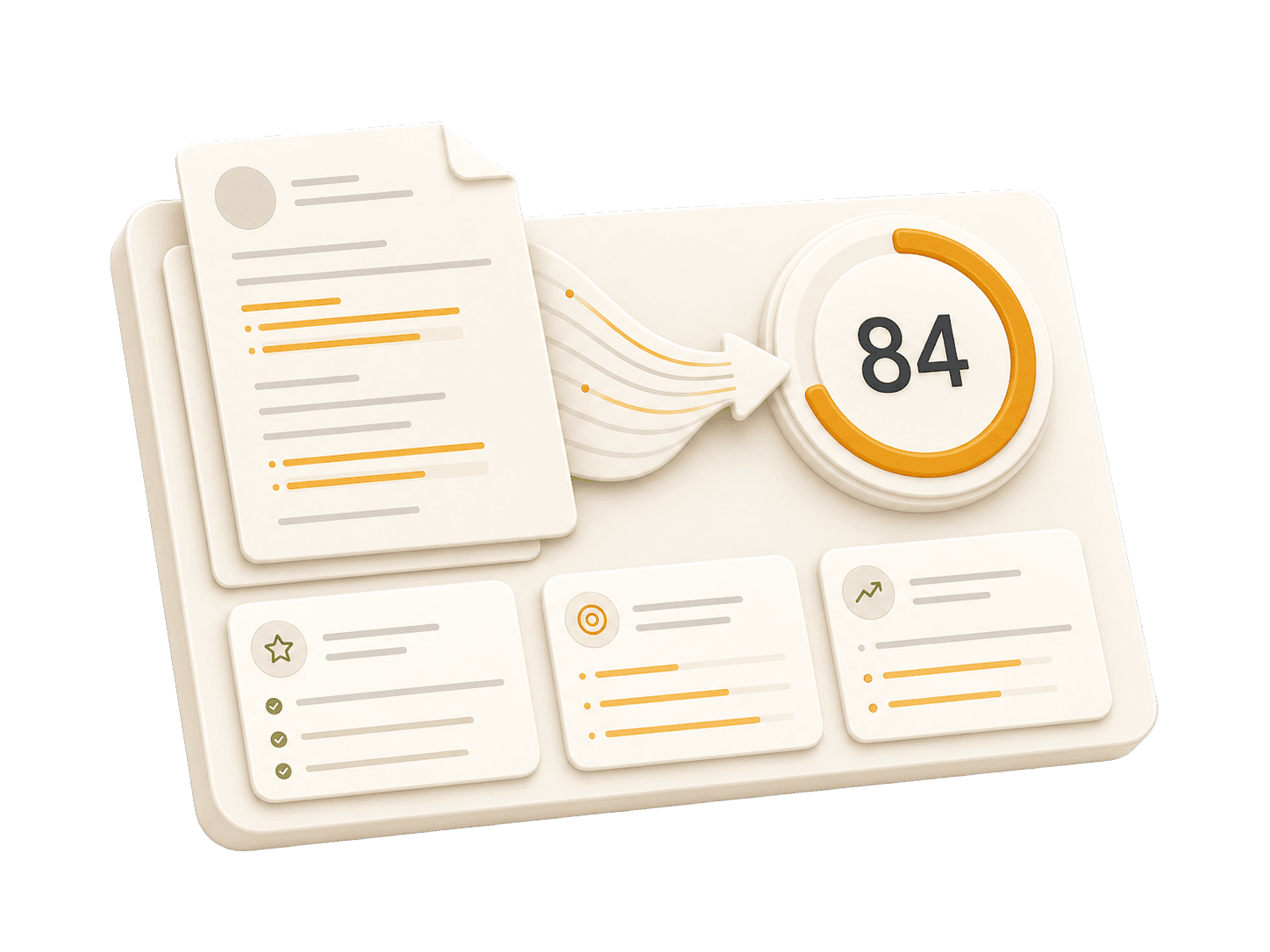
Add your resume to run a free score and get prioritized fixes.
Expert guidelines and best practices for each section of your resume.
01
First Name Last Name City, State, Zip Code Phone Number | Email Address LinkedIn Profile URL | Portfolio URL (Optional)
Your contact information is the first section recruiters see. Keep it concise and professional. Ensure your email address is appropriate (e.g., [email protected]). Include your LinkedIn profile for a comprehensive view of your professional journey. A portfolio or personal website is recommended for creative, technical, or design roles.
Do not include your full physical address (street number/name) for privacy reasons. Avoid including personal details like marital status, age, photo, or social security number unless specifically required in your country. Don't use unprofessional email addresses.
See clear examples of how to format contact details effectively.
John Doe 1234 Random St, Apt 56 New York, NY 10001 [email protected] github.com/aliciacode Single, 28 years old
John Doe New York, NY (555) 123-4567 | [email protected] linkedin.com/in/johndoe | johndoe.com
02
Professional Title
Result-oriented [Role Name] with [Number] years of experience in [Key Skills/Industries]. Proven track record of [Major Achievement]. Skilled in [Key Technologies/Skills]. Committed to delivering [Specific Value] for [Target Industry/Company type].
A professional summary is your elevator pitch. It should be 3-5 sentences long, summarizing your experience, key skills, and major achievements. Tailor it to the job description by using relevant keywords. Focus on what makes you unique and the value you bring to potential employers.
Avoid generic objectives like 'Looking for a challenging role to grow my skills.' Recruiters want to know what value you bring to them, not what you want from them. Don't use first-person pronouns (I, me, my). Keep it concise and impactful.
Compare a weak objective with a strong professional summary.
Objective: I am a hard-working individual looking for a Amazon Product Manager position where I can learn new things and advance my career.
Senior Amazon Product Manager with 6+ years of experience in e-commerce product development. Reduced user churn by 25% through strategic AI-driven analytics initiatives. Skilled in Tableau, PowerBI, and Amazon SageMaker for data-driven decision-making.
Another example comparing weak and strong professional summaries.
Objective: To obtain a Product Manager position at an innovative company that offers opportunities to learn and grow professionally.
Product Manager with 5 years of experience in scaling niche products into international markets. Doubled user engagement rates through AI-driven recommendation systems. Proficient in cross-functional collaboration and agile project management.
03
Technical Skills
Soft Skills
Group your skills logically (e.g., Languages, Frameworks, Tools). Focus on hard skills relevant to the job. List skills in order of proficiency or relevance. Soft skills are better demonstrated through bullet points in your experience section rather than a bare list.
Do not list skills you are not comfortable using in an interview. Avoid using progress bars or percentages to rate your skills (e.g., "Java: 80%"). Do not include outdated technologies unless specifically required.
Practical example showing do's and don'ts for skills
C#, Java, SQL; Python, Ruby; Jira, Trello, Slack; Project Management, Team Collaboration, Leadership
Excelled in HTML and CSS development for over 10 years
Experienced with HTML5 and CSS3 for front-end web design.
04
Job Title | Company Name | Location Month Year – Month Year
This is the core of your resume. Use reverse-chronological order (most recent first). Start each bullet with a strong action verb. Focus on achievements and impact, not just duties. Use numbers to quantify your impact (dollars, percentages, time saved, users affected). Show progression and increasing responsibility.
Avoid passive language like 'Responsible for...' or 'Tasked with...'. Don't list every single daily task; focus on significant contributions and measurable outcomes. Avoid jargon that recruiters outside your field won't understand.
Practical example showing do's and don'ts for experiences
Managed product development processes to ensure timely release of new features.
Led the successful launch of five new product features, increasing user engagement by 20%.
Worked on data analysis to improve recommendation algorithms for users.
Implemented an AI-driven analytics system that improved product recommendation accuracy by 30%, boosting user engagement.
05
Degree Name | University Name | Location Month Year – Month Year
List your highest degree first. If you have significant work experience, keep the education section brief. Include your GPA only if it is above 3.5 or if you are a recent graduate. Highlight relevant coursework, academic projects, honors, or leadership roles.
Do not include high school details if you have a college degree. Avoid listing every single course you took; select only the most relevant ones. Don't include graduation dates from decades ago if age discrimination is a concern in your field.
Practical example showing do's and don'ts for educations
Bachelor of Arts | University of Washington | Seattle, WA January 2018 – December 2022
Master of Science in Information Management | University of Washington | Seattle, WA September 2015 – June 2017
06
Project Name | Tools/Technologies Used
Projects are excellent for demonstrating practical skills, especially if you lack work experience or are changing careers. Include a link to your portfolio or demo if possible. Focus on projects that show problem-solving skills and relevant tools for the target role.
Don't include trivial tutorials unless you significantly expanded on them. Avoid projects that are outdated, incomplete, or irrelevant to the role you're applying for. Don't just list technologies—explain what you created and why it matters.
Practical example showing do's and don'ts for projects
Developed a basic AI chatbot using Python (2025-01). This project taught me the basics of natural language processing but did not have any real-world application.
Built an AI-driven recommendation engine using Amazon SageMaker and TensorFlow (2025-03) to enhance user engagement on a retail platform. The challenge was integrating real-time data feeds into predictive models for personalized product recommendations.
Common questions about this role and how to best present it on your resume.
Focus on customer problems, roadmap ownership, cross-functional delivery, and measurable outcomes such as conversion, retention, cost savings, or operational efficiency.
Start with the product area or initiative, explain the action you led, and end with a clear business result. Use metrics when they are real and easy to explain in an interview.
Prioritization, experimentation, stakeholder communication, analytics, and customer insight are core. Familiarity with e-commerce funnels, metrics, and execution at scale also helps.
Mirror the language of the job description, swap in the most relevant product area examples, and move the strongest matching metrics higher in the summary and experience sections.
Create a professional, optimized resume in minutes. No design skills needed—just proven results.
The average job seeker spends 3+ hours formatting a resume. Our AI does it in under 15 minutes, getting you to the application phase 12x faster.